
Not so obvious in fact
Originally published on Substack.
Although the Twitter post is clear bait for discussion, the topic is interesting for discussion:
Find the log base 2 of an N-bit integer in O(lg(N)) operations with multiply and lookup
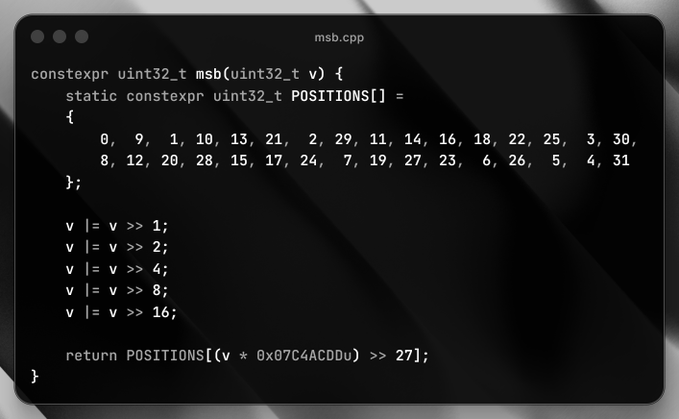
This code snippet is a direct copy from Bit Twiddling Hacks, which has very amusing low-level code snippets and some history on optimizing them (The Hacker’s Delight is another source of such low-level tricks).
And this is provided as a compiler builtin for a long time by both gcc and clang as __builtin_ctz. The built-in has some inherent issues:
-
It maps to default C types, so using it with fixed-width integer types requires extra care from the user.
-
If the input is 0, the result is undefined. This is because some architectures return different values for 0, and to avoid adding the burden of extra checks on a specific architecture, the simpler solution is to make undefined behavior.
The builtin was introduced in GCC version 3.0 (2001), and it took another 22 years for the C standard to address the two issues above with stdbit.h. With a C23 runtime, one can just use stdc_trailing_zeros regardless of the input type and value.
C++ also provides similar bit manipulation support, and one can just use std::countr_zero. Also, C++26 will provide the C23 stdbit.h support through cstdbit.
But back to the De Bruijn sequence code snippet: why should one know or even use it nowadays? The odds are that the CPU your code targets should support the intrinsic. For the ABIs glibc supports:
ABI support for __builtin_ctzl (using gcc 15)
| Architecture | Instructions / libcall | Notes |
|---|---|---|
| aarch64 | rbit + clz | |
| alpha | __ctzdi2 | ev67 added cttz |
| arc | ffs | |
| arm | rsb + clz | |
| csky | __ctzdi2 | |
| hppa | __ctzdi2 | |
| i686 | rep bsfl | |
| loongarch | ctz.w | |
| m68k | bfffo | |
| microblaze | __ctzsi2 | |
| mips | __ctzdi2 | mips32r5 / mips64 added clz |
| or1k | __ctzsi2 | |
| powerpc | cntlzw | |
| riscv | __ctzsi2 | zbb extension added ctzw |
| s390 | __ctzsi2 | z9-ec/arch7 added flogr |
| sh | __ctzsi2 | |
| sparc | __ctzdi2 | VIS3 added lzd |
| x86_64 | rep bsfl |
So for a handful of ABIs, the compiler emits library calls (the __ctzsi2 and __ctzdi2) that implement the builtin operation. For gcc, this is implemented in libgcc, which is commonly linked for all binaries and provides some optimized implementations for different architectures.
The generic implementation uses an internal macro names count_trailing_zeros defined in a very convoluted header that also provides different optimizations for multiple targets. The generic implementation boils down to:
#define count_trailing_zeros(count, x)                  \
   do {                                                 \
     UWtype __ctz_x = (x);                              \
     UWtype __ctz_c;                                    \
     count_leading_zeros (__ctz_c, __ctz_x & -__ctz_x); \
     (count) = W_TYPE_SIZE - 1 - __ctz_c;               \
   } while (0)
 #endif
And count_leading_zero to:
#define count_leading_zeros(count, x)                                 \
  do {                                                                \
    UWtype __xr = (x);                                                \
    UWtype __a;                                                       \
                                                                      \
    if (W_TYPE_SIZE <= 32)                                            \
      {                                                               \
        __a = __xr < ((UWtype)1<<2*__BITS4)                           \
          ? (__xr < ((UWtype)1<<__BITS4) ? 0 : __BITS4)               \
          : (__xr < ((UWtype)1<<3*__BITS4) ?  2*__BITS4 : 3*__BITS4); \
      }                                                               \
    else                                                              \
      {                                                               \
        for (__a = W_TYPE_SIZE - 8; __a > 0; __a -= 8)                \
          if (((__xr >> __a) & 0xff) != 0)                            \
            break;                                                    \
      }                                                               \
                                                                      \
    (count) = W_TYPE_SIZE - (__clz_tab[__xr >> __a] + __a);           \
  } while (0)
A more readable code is:
constexpr uint32_t W_TYPE_SIZE = 32;
constexpr uint32_t BITS4 = W_TYPE_SIZE/4;

constexpr uint32_t gcc_clz (uint32_t v)
{
  static constexpr uint8_t __clz_tab[256] =
  {
    0,1,2,2,3,3,3,3,4,4,4,4,4,4,4,4,5,5,5,5,5,5,5,5,5,5,5,5,5,5,5,5,
    6,6,6,6,6,6,6,6,6,6,6,6,6,6,6,6,6,6,6,6,6,6,6,6,6,6,6,6,6,6,6,6,
    7,7,7,7,7,7,7,7,7,7,7,7,7,7,7,7,7,7,7,7,7,7,7,7,7,7,7,7,7,7,7,7,
    7,7,7,7,7,7,7,7,7,7,7,7,7,7,7,7,7,7,7,7,7,7,7,7,7,7,7,7,7,7,7,7,
    8,8,8,8,8,8,8,8,8,8,8,8,8,8,8,8,8,8,8,8,8,8,8,8,8,8,8,8,8,8,8,8,
    8,8,8,8,8,8,8,8,8,8,8,8,8,8,8,8,8,8,8,8,8,8,8,8,8,8,8,8,8,8,8,8,
    8,8,8,8,8,8,8,8,8,8,8,8,8,8,8,8,8,8,8,8,8,8,8,8,8,8,8,8,8,8,8,8,
    8,8,8,8,8,8,8,8,8,8,8,8,8,8,8,8,8,8,8,8,8,8,8,8,8,8,8,8,8,8,8,8
  };

  uint32_t a = v < (1U<<2*BITS4)
               ? v < (1U<<BITS4)   ? 0         : BITS4
               : v < (1U<<3*BITS4) ? 2 * BITS4 : 3 * BITS4;
  return W_TYPE_SIZE - (__clz_tab[v >> a] + a);
}

uint32_t gcc_ctz (uint32_t v)
{
  return W_TYPE_SIZE - 1 - gcc_clz (v & -v);
}
And how does it compare to the initial implementation that motivates this post? It depends. On both x86_64 and aarch64, for instance, it generates more code, with changes, and using a large table. So why does libgcc use this implementation instead of the De Bruijn-based one?
Because the generic code avoids the need for a 32x32 bit multiplier, which on simple CPUs (that most likely do not provide bit manipulation instructions) might have higher latency and lower throughput. The generic implementation is a trade-off between good-enough performance and code complexity, and since performance varies by CPU core, both gcc and libgcc also provide arch-specific optimizations. The compiler-rt also uses a multiplication-free implementation.
The De Bruijn sequence is an interesting method for finding the least- or most-significant set bit in a word, but either the toolchain or the architectures will likely provide better, faster interfaces for this.